Read prediction markets
On this page
This guide explains how to read the numbers on Predictions so you can judge them for yourself: what a chance is, how much money stands behind it, whether other venues agree, what moved it, and how well such numbers have held up.
#What a chance means
A prediction market trades contracts that pay $1 if something happens. A contract at 62¢ means traders give it a 62% chance. The number shown is the midpoint between the best bid and the best offer, or the last trade when the two are more than ten cents apart, read from the venue every few minutes.
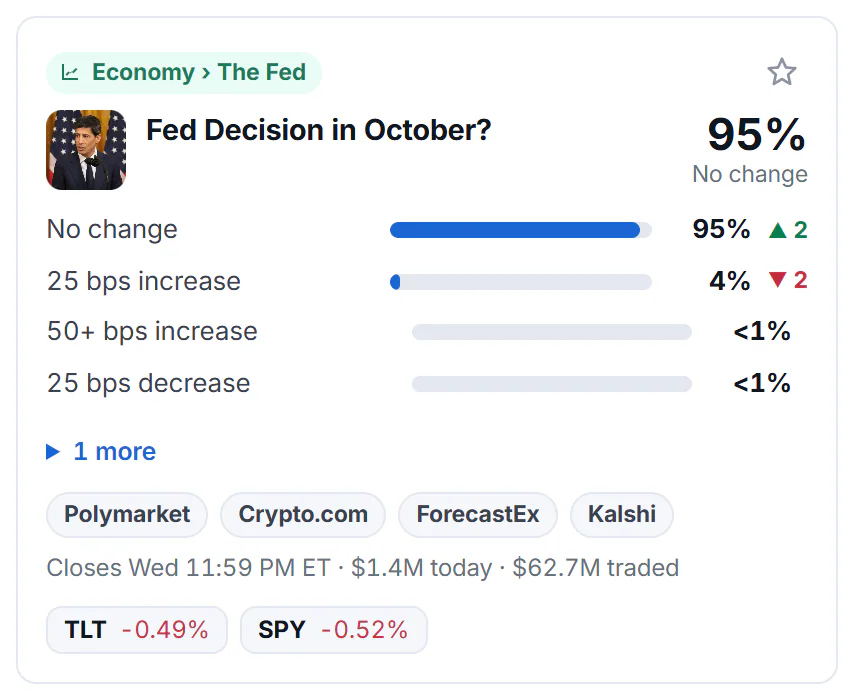
A market card: the topic, the leading answer and its chance, the other answers, the venue chips and the money.
- 1Topic
- 2Follow star
- 3Leading answer and its chance
- 4Every answer, with its move today
- 5Venues that list it
- 6When it is decided, and the money
- ▲ 2 or ▼ 2 beside an answer is how many percentage points it moved in the last day.
- For a question with many answers, the chances are scaled to add up to 100%.
- A 70% outcome still fails about three times in ten.
To write chances as American or decimal odds, use the %, US and Dec switch. See How to read the odds and Show odds as percentages, American odds or decimal odds.
#Weigh it by the money behind it
The last line of a card says how much has traded, such as $1.4M today · $62.7M traded. On a market's page you also see At stake, what traders hold right now.
- Look at the money first. A market with little money is thin, and one trade can move its price.
- Open the market and find the Every outcome table. A wide gap between Bid and Ask usually means few traders.
- Check Closes: a market about to close drifts toward 0 or 100 as the moment nears.
Kalshi and ForecastEx count contracts, so their money is shown as an estimate in dollars. See The venues Predictions brings together.
#Compare the venues
Where more than one venue asks the same question, each venue's number is shown, never an average. A card's venue chips can carry their own numbers, such as Kalshi 62%, and a market's page has a box named The same question on and the other venue.
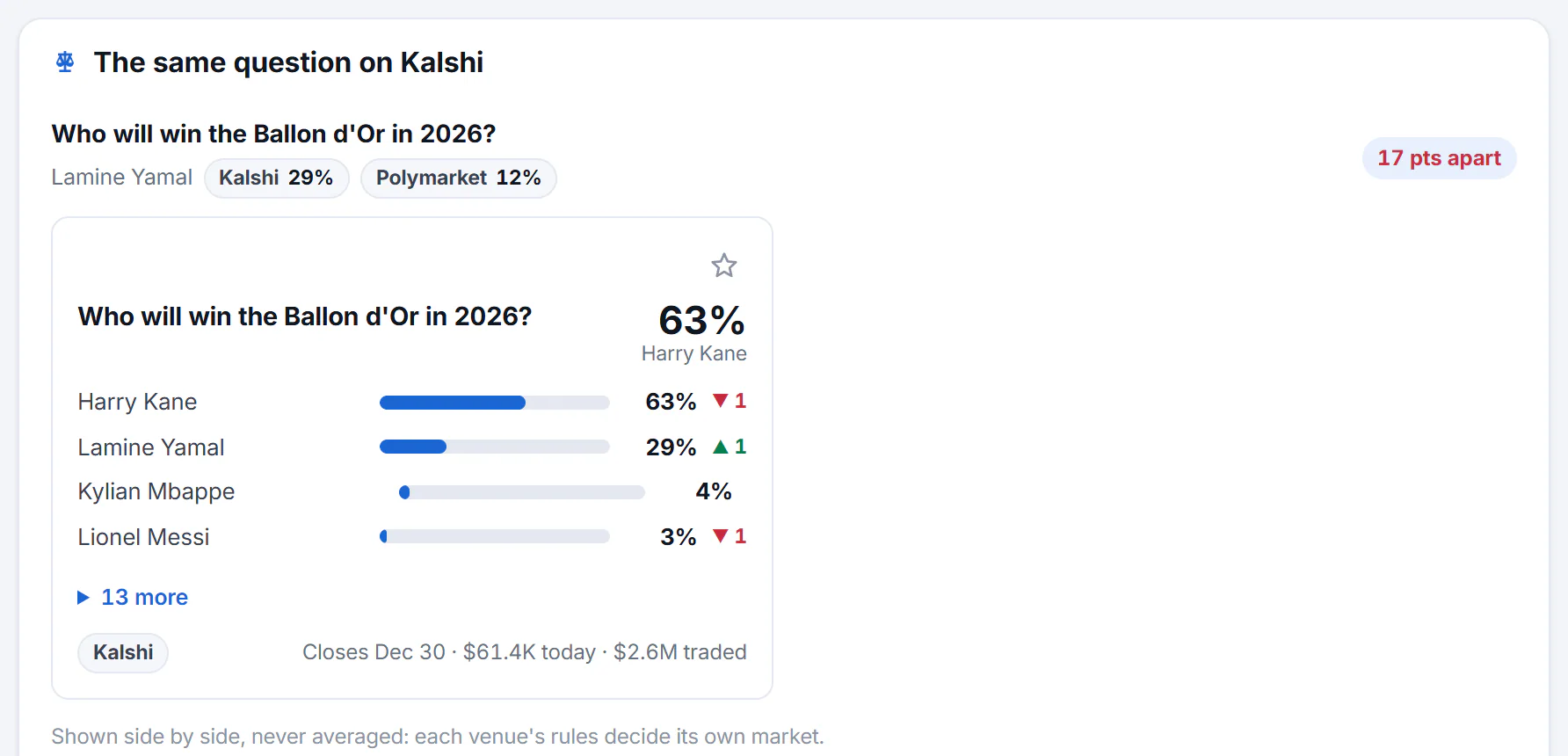
The same question on another venue, with how many points apart the two chances are.
- 1Each venue's number for the same outcome
- 2How many points apart
- 3The other venue's market
Venues Compared in the row of Predictions pages ranks the pairs by how far apart they are; a gap of five points or more is shown in red. A big gap can mean the two markets are not quite the same question, so read both venues' rules before comparing. See Compare venues.
#See what moved, and why
- Open Movers and choose Today or This week. Rising and Falling list the markets whose chances changed most, in percentage points.
- Open a market. Its chart draws each leading answer over time, with dots along the bottom for headlines about its subject.
- Where there were big swings with headlines just before them, a Why it moved box lists each swing with those headlines.
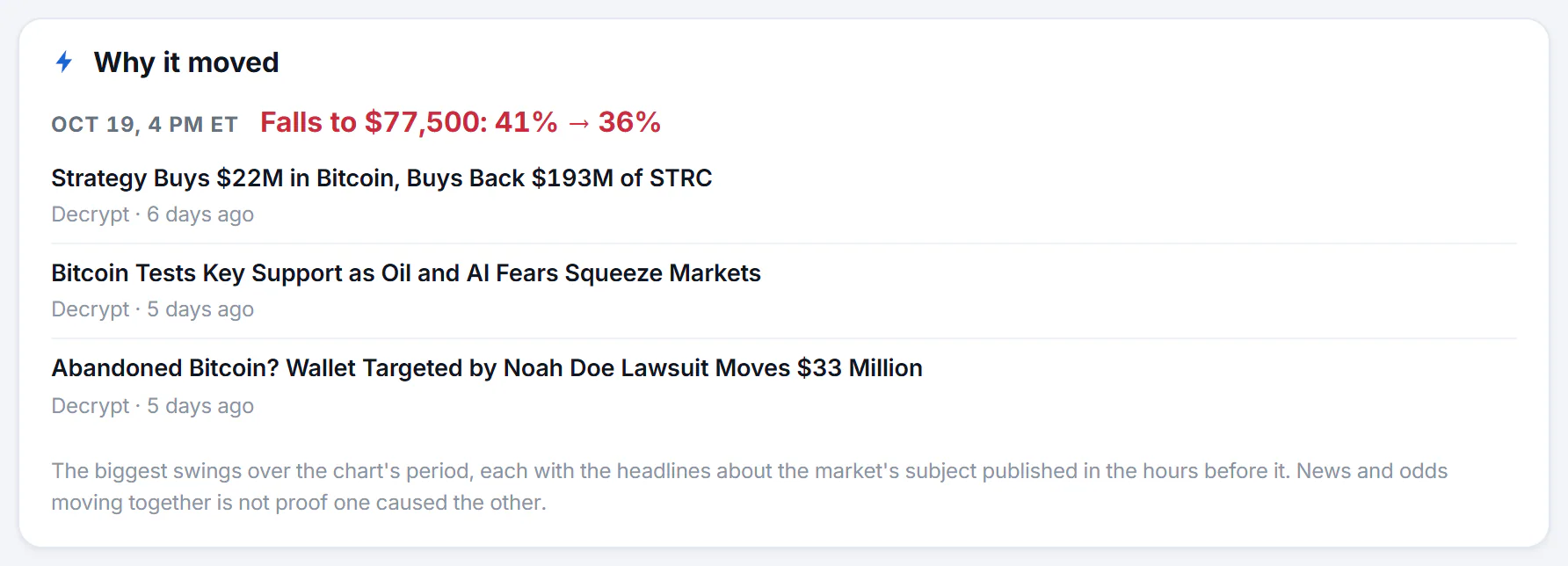
A swing, with the headlines published in the hours before it.
- 1When the swing happened
- 2How far the chance moved
- 3Headlines from the hours before
- 4A reminder that timing is not proof
Markets that close within a day and thin markets are left out of Movers. A past move does not tell you where a price goes next. See The biggest moves and Read a market's page.
#Check the track record
Track Record compares settled markets with the chance traders gave each outcome a day before they closed.
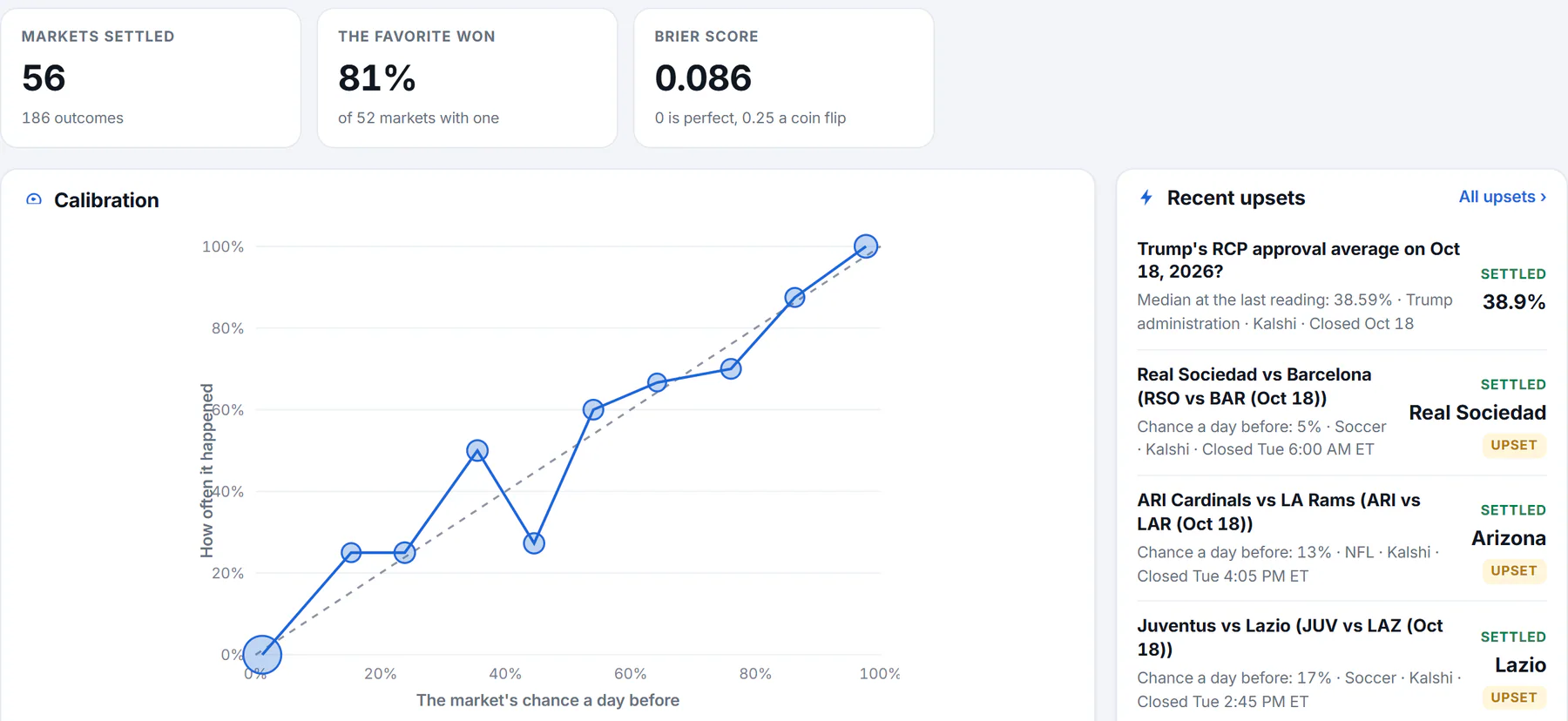
Markets settled, how often the favorite won, the Brier score and the calibration chart.
- 1How many markets it covers
- 2How often the favorite won
- 3Brier score: 0 is perfect
- 4Calibration: the dashed line is a perfect market
- The favorite won is how often the answer ahead a day before went on to win.
- Brier score runs from 0, perfect, to 0.25, what calling everything 50% would score. Lower is better.
- Calibration shows whether things priced at 70% happened about 70% of the time.
Read the outcome counts before the percentages: a record on few markets says little. See Track Record.
#Know the limits
- Prices can be a few minutes old; the page says when they were last read.
- Polymarket's end dates are estimates, and a market can stay open past them as Result pending.
- Each venue's own rules decide how its market settles. The venue chip opens the market there, where its terms apply.
#Common questions
Is a prediction market the same as a poll?
No. A poll asks people what they think; a market's price is what traders are paying on an outcome. Neither is a forecast by 4Search.
Which venue should I trust?
Predictions does not rank them. Compare their numbers, the money behind each, and their rules.
Can I place a trade here?
No. Predictions only shows the odds and the news.